CAS RN: 287399-26-2
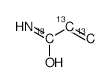
ACRYLAMIDE-13C3
Product Availability
Choose a grade to view its available package options.
1 package records1 with current stock1 grade group
| Batch No. | Package | Availability | Warehouse | Inquiry |
|---|---|---|---|---|
| Batchno.20260314 | 10mg | In stock | Shanghai | Inquiry |
- Product code: starshine_CAS287399-26-2
- Purity/Analytical Methods: >99.0%
287399-26-2 / prop-2-enamide
Basic Information
CAS
287399-26-2
Multi CAS
Yes
Molecular Formula
C3H5NO
Molecular Weight
71.080000
Exact Mass
71.037114
InChI
InChI=1S/C3H5NO/c1-2-3(4)5/h2H,1H2,(H2,4,5)/i1+1,2+1,3+1
InChIKey
HRPVXLWXLXDGHG-VMIGTVKRSA-N
Physical Properties
Melting Point
184 °F (EPA, 1998)
84.5 °C
184 °F
Boiling Point
189 °F at 2 mmHg (EPA, 1998)
192.6 °C
192.60 °C. @ 760.00 mm Hg
347-572 °F (decomposes)
347-572 °F (Decomposes)
Density
1.122 at 86 °F (EPA, 1998) - Denser than water; will sink
1.122 at 30 °C/4 °C
1.13 g/cm³
1.12
Physical Description
Acrylamide appears as white crystalline solid shipped either as a solid or in solution. A confirmed carcinogen. Toxic by skin absorption. Less dense than water and soluble in water. May be toxic by ingestion. Used for sewage and waste treatment, to make dyes, adhesives. The solid is stable at room temperature, but upon melting may violently polymerize. Toxic, irritating to skin, eyes, etc.
Acrylamide solution, [aqueous] appears as a colorless aqueous solution of a solid. Often at a concentration of 40% (w/v). Spills can easily penetrate the soil and contaminate groundwater and nearby streams. Used for sewage and waste treatment and to make dyes and adhesives. Toxic, irritating to skin, eyes, etc. Produce toxic oxides of nitrogen when burned.
Acrylamide solution, [flammable liquid label] appears as a solution of a colorless crystalline solid. Flash point depends on the solvent but below 141 °F. Less dense than water. Vapors heavier than air. Toxic oxides of nitrogen produced during combustion. Used for sewage and waste treatment, to make dyes and adhesives.
Pellets or Large Crystals; Other Solid; Liquid; Dry Powder
White crystalline, odorless solid; [NIOSH]
Appearance
Flake-like crystals from benzene
White crystalline ... solid
State
Solid
Computed Properties
Structural Parameters
Heavy atom count
5
Rotatable bonds
1
H-bond acceptors
1
H-bond donors
1
Molar refractivity
19.39
TPSA
43.09
LogP / Solubility
WLOGP
-0.34
MLOGP
-0.32
XLogP3
-0.7
Consensus LogP
-0.45
Class (ESOL)
Highly soluble
Log S (Ali)
0.1
Class (Ali)
Highly soluble
Log S (SILICOS-IT)
0.04
Class (SILICOS-IT)
Highly soluble
ADME
GI absorption
High
BBB permeant
Yes
P-gp substrate
No
CYP1A2 inhibitor
No
CYP2C19 inhibitor
No
CYP2C9 inhibitor
No
CYP2D6 inhibitor
No
CYP3A4 inhibitor
No
Log Kp (skin permeation)
-3.4
Drug-likeness / Medicinal Chemistry
Lipinski
Yes
Ghose
No
Veber
Yes
Egan
Yes
Muegge
No
Bioavailability score
0.55
Brenk alerts
1
Leadlikeness
No
Synthetic Accessibility
1
Customers Also Viewed
-

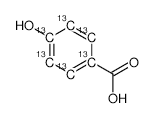
4-Hydroxybenzoic-1,2,3,4,5,6-13C6 Acid
- CAS RN: 287399-29-5
- Product Code: starshine_CAS287399-29-5
- Purity/Analytical method: >99.0%
-
1-Piperidineacetic acid, 4-[(4-amino-5-chloro-2-methoxybenzoyl)amino]-, butyl ester
- CAS RN: 287399-47-7
- Product Code: starshine_CAS287399-47-7
- Purity/Analytical method: >99.0%
-
Acetic acid, 2-[(1S)-1-phenylethoxy]-
- CAS RN: 287400-90-2
- Product Code: starshine_CAS287400-90-2
- Purity/Analytical method: >99.0%
-
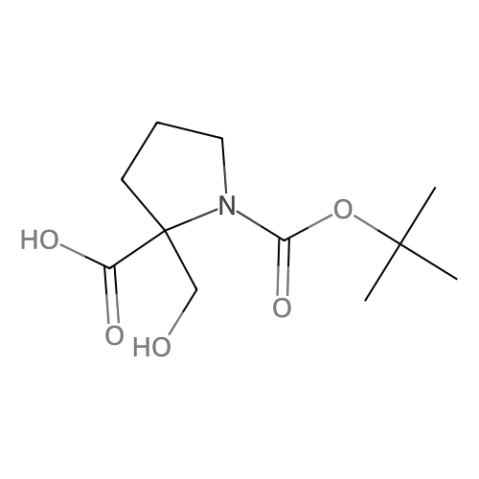
(R)-1-(tert-butoxycarbonyl)-2-(hydroxymethyl)pyrrolidine-2-carboxylic acid
- CAS RN: 287401-41-6
- Product Code: SSC-130418
-
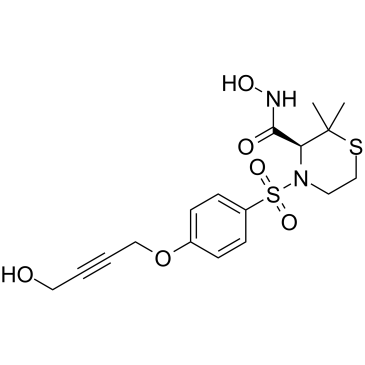
TMI 1
- CAS RN: 287403-39-8
- Product Code: starshine_CAS287403-39-8
- Purity/Analytical method: >99.0%
-
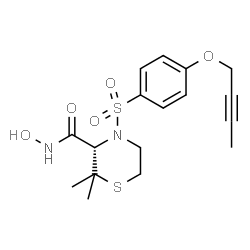
apratastat
- CAS RN: 287405-51-0
- Product Code: starshine_CAS287405-51-0
- Purity/Analytical method: >99.0%
![CAS 287399-47-7 1-Piperidineacetic acid, 4-[(4-amino-5-chloro-2-methoxybenzoyl)amino]-, butyl ester molecular structure](https://starshinechemical.com/wp-content/uploads/2023/05/287399-47-7.png)
![CAS 287400-90-2 Acetic acid, 2-[(1S)-1-phenylethoxy]- molecular structure](https://starshinechemical.com/wp-content/uploads/2023/05/287400-90-2.png)