Historical Factory Record
Historical Supply Reference
This product has historical factory records. Recorded pack sizes and purity can be used as a supply reference, while project-specific availability is confirmed by inquiry.
- Pack sizes on record: 100g
- Available purity: ≥95%
- Inventory rows with stock: 0
- Bulk packaging: confirmed by inquiry
Reference Pack Sizes
Reference pack sizes are shown below. Final availability, packaging and delivery schedule are confirmed by inquiry.
| Pack Size | Recorded Purity | Available Qty | Ship From | Inquiry |
|---|---|---|---|---|
| 100g | ≥95% | 0 Out of Stock | Beijing | Inquiry |
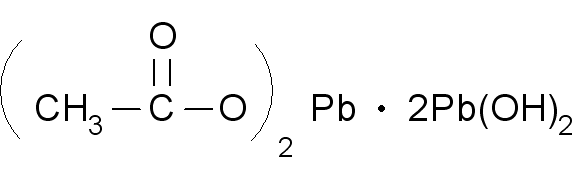
1335-32-6 / tris(lead(2+));diacetate;tetrahydroxide
Basic Information
CAS
1335-32-6
Multi CAS
No
Molecular Formula
C4H10O8Pb3
Molecular Weight
810.000000
Exact Mass
807.965340
SMILES
CC(=O)[O-].CC(=O)[O-].[OH-].[OH-].[OH-].[OH-].[Pb+2].[Pb+2].[Pb+2]
InChI
InChI=1S/2C2H4O2.4H2O.3Pb/c2*1-2(3)4;;;;;;;/h2*1H3,(H,3,4);4*1H2;;;/q;;;;;;3*+2/p-6
InChIKey
VLOJXAQYHIVPFI-UHFFFAOYSA-H
Physical Properties
Melting Point
75 °C
Boiling Point
Decomposes at 200 °C
Physical Description
Lead subacetate is a white dense powder. (NTP, 1992)
White solid; [Merck Index] Very soluble in water; [[Ullmann]
Appearance
White, heavy powder
State
Solid
Storage Conditions
STORAGE PRECAUTIONS: You should store this material in a refrigerator. (NTP, 1992)
Store in tightly closed containers in a cool, well-ventilated area away from heat, oxidizers, strong acids ... A regulated, marked area should be established where this chemical is handled, used, or stored ...
PRECAUTIONS FOR "CARCINOGENS": Storage site should be as close as practicable to lab in which carcinogens are to be used, so that only small quantities required for ... expt need to be carried. Carcinogens should be kept in only one section of cupboard, an explosion-proof refrigerator or freezer (depending on chemicophysical properties ...) that bears appropriate label. An inventory ... should be kept, showing quantity of carcinogen & date it was acquired ... Facilities for dispensing ... should be contiguous to storage area. /Chemical Carcinogens/
Computed Properties
Structural Parameters
Heavy atom count
15
Fraction Csp3
0.5
H-bond acceptors
8
H-bond donors
4
Molar refractivity
46.37
TPSA
200.26
LogP / Solubility
WLOGP
-4.34
MLOGP
-3.74
XLogP3
-4.34
Consensus LogP
-4.14
Log S (ESOL)
-2.12
Class (ESOL)
Moderately soluble
Log S (Ali)
-3.05
Class (Ali)
Poorly soluble
Log S (SILICOS-IT)
-1.31
Class (SILICOS-IT)
Soluble
ADME
GI absorption
Low
BBB permeant
No
P-gp substrate
No
CYP1A2 inhibitor
No
CYP2C19 inhibitor
No
CYP2C9 inhibitor
No
CYP2D6 inhibitor
No
CYP3A4 inhibitor
No
Log Kp (skin permeation)
-10.73
Drug-likeness / Medicinal Chemistry
Lipinski
Yes
Ghose
No
Veber
No
Egan
No
Muegge
No
Bioavailability score
0.55
Leadlikeness
No
Synthetic Accessibility
1.5
Safety & Transport
Pictogram(s)
Health Hazard
Environmental Hazard
Irritant
Signal
Danger
GHS Hazard Statements
H351: Suspected of causing cancer [Warning Carcinogenicity]
H360Df: May damage the unborn child; Suspected of damaging fertility [Danger Reproductive toxicity]
H373 **: May causes damage to organs through prolonged or repeated exposure [Warning Specific target organ toxicity, repeated exposure]
H400: Very toxic to aquatic life [Warning Hazardous to the aquatic environment, acute hazard]
H410: Very toxic to aquatic life with long lasting effects [Warning Hazardous to the aquatic environment, long-term hazard]
Precautionary Statement Codes
P203, P260, P273, P280, P318, P319, P391, P405, and P501
P203, P260, P264, P270, P280, P308+P316, P318, P319, P321, P405, and P501
P203, P260, P261, P271, P273, P280, P304+P340, P317, P318, P319, P391, P405, and P501
Customers Also Viewed
-

-
-
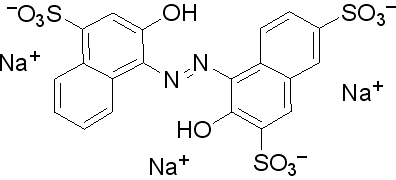
Hydroxynaphthol blue, indicator for metal titration
- CAS RN: 63451-35-4
- Product Code: SSC-173141
-
-
-
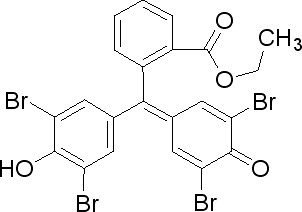
3′,3”,5′,5”-Tetrabromophenolphthaleinethyl ester, 80%, for microscopy
- CAS RN: 1176-74-5
- Product Code: SSC-017441