Historical Factory Record
Historical Supply Reference
This product has historical factory records. Recorded pack sizes and purity can be used as a supply reference, while project-specific availability is confirmed by inquiry.
- Pack sizes on record: 500g
- Available purity: >97%
- Inventory rows with stock: 0
- Bulk packaging: confirmed by inquiry
Reference Pack Sizes
Reference pack sizes are shown below. Final availability, packaging and delivery schedule are confirmed by inquiry.
| Pack Size | Recorded Purity | Available Qty | Ship From | Inquiry |
|---|---|---|---|---|
| 500g | >97% | 0 Out of Stock | Shenzhen | Inquiry |
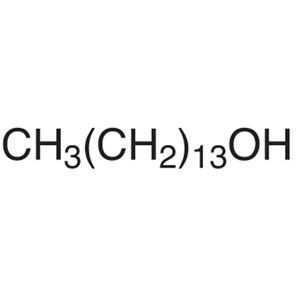
112-72-1 / tetradecan-1-ol
1-TETRADECANOL | Tetradecan-1-ol | Myristyl alcohol
Basic Information
CAS
112-72-1
Multi CAS
Yes
Molecular Formula
C14H30O
Molecular Weight
214.390000
Exact Mass
214.229666
SMILES
CCCCCCCCCCCCCCO
InChI
InChI=1S/C14H30O/c1-2-3-4-5-6-7-8-9-10-11-12-13-14-15/h15H,2-14H2,1H3
InChIKey
HLZKNKRTKFSKGZ-UHFFFAOYSA-N
Synonyms
1-TETRADECANOL
Tetradecan-1-ol
Myristyl alcohol
Tetradecyl alcohol
n-Tetradecanol
Physical Properties
Melting Point
99.7 °F (USCG, 1999)
37.7 °C
Liquid Molar Volume = 0.2604 cu m/kmol (determined at the triple point); IG Heat of Formation = -4.8409X10+8 J/kmol; Heat of Fusion at Melting Point = 4.9510X10+7 J/kmol (determined for the beta form)
39.5 °C
Boiling Point
505.8 °F at 760 mmHg (USCG, 1999)
295.8 °C
Density
0.824 at 100.4 °F (USCG, 1999) - Less dense than water; will float
0.823 at 40 °C
Bulk density = 7.0 lb/gal; specific gravity: 0.8355 at 20 °C/20 °C
Density: 0.8236 g/cu cm at 38 °C
Physical Description
Tetradecanol is a colorless thick liquid (heated) with a faint alcohol odor. Solidifies and floats on water. (USCG, 1999)
Liquid; Liquid, Other Solid
White solid; [Merck Index]
Solid
Appearance
White solid
White crystals
Leaflets
State
Solid
Computed Properties
Structural Parameters
Heavy atom count
15
Fraction Csp3
1
Rotatable bonds
12
H-bond acceptors
1
H-bond donors
1
Molar refractivity
68.16
TPSA
20.23
LogP / Solubility
WLOGP
4.68
MLOGP
4.12
XLogP3
6.2
Consensus LogP
5
Log S (ESOL)
-3.33
Class (ESOL)
Poorly soluble
Log S (Ali)
-4.7
Class (Ali)
Slightly soluble
Log S (SILICOS-IT)
-6.38
Class (SILICOS-IT)
Insoluble
ADME
GI absorption
High
BBB permeant
No
P-gp substrate
No
CYP1A2 inhibitor
No
CYP2C19 inhibitor
No
CYP2C9 inhibitor
No
CYP2D6 inhibitor
No
CYP3A4 inhibitor
No
Log Kp (skin permeation)
-0.71
Drug-likeness / Medicinal Chemistry
Lipinski
Yes
Ghose
No
Veber
No
Egan
Yes
Muegge
No
Bioavailability score
0.55
Brenk alerts
1
Leadlikeness
No
Synthetic Accessibility
1.5
Safety & Transport
Pictogram(s)
Irritant
Environmental Hazard
Signal
Warning
GHS Hazard Statements
H315 (33.1%): Causes skin irritation [Warning Skin corrosion/irritation]
H319 (46.6%): Causes serious eye irritation [Warning Serious eye damage/eye irritation]
H400 (13.5%): Very toxic to aquatic life [Warning Hazardous to the aquatic environment, acute hazard]
H410 (29%): Very toxic to aquatic life with long lasting effects [Warning Hazardous to the aquatic environment, long-term hazard]
H411 (13%): Toxic to aquatic life with long lasting effects [Hazardous to the aquatic environment, long-term hazard]
Precautionary Statement Codes
P264, P264+P265, P273, P280, P302+P352, P305+P351+P338, P321, P332+P317, P337+P317, P362+P364, P391, and P501
P273, P391, and P501
P264+P265, P273, P280, P305+P351+P338, P337+P317, P391, and P501
Customers Also Viewed
-

-
1-Hexacosanol
- CAS RN: 506-52-5
- Product Code: ICTH0342
- Purity/Analytical method: >95.0%(GC)
-
-
-
-