CAS RN: 1622-32-8
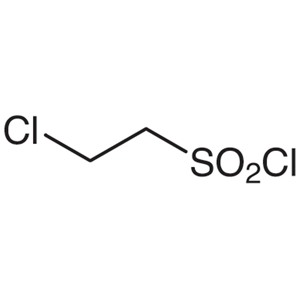
2-Chloroethanesulfonyl Chloride
Product Availability
Choose a grade to view its available package options.
1 package records1 with current stock1 grade group
| Batch No. | Package | Availability | Warehouse | Lead Time | Inquiry |
|---|---|---|---|---|---|
| Batchno.20251226 | 1g / 5g / 25g / 100g / 500g / 2.5kg | Confirm by inquiry | Shanghai, Shandong, Guangdong, Chongqing, Hebei | 8-10 business days | Inquiry |
- Product code: ICTC1142
- Purity/Analytical Methods: >95.0%(GC)(T)
1622-32-8 / 2-chloroethanesulfonyl chloride
Basic Information
CAS
1622-32-8
Multi CAS
No
Molecular Formula
C2H4Cl2O2S
Molecular Weight
163.020000
Exact Mass
161.930906
SMILES
C(CCl)S(=O)(=O)Cl
InChI
InChI=1S/C2H4Cl2O2S/c3-1-2-7(4,5)6/h1-2H2
InChIKey
VHCSBTPOPKFYIU-UHFFFAOYSA-N
Physical Properties
Boiling Point
392 to 397 °F at 760 mmHg (EPA, 1998)
200-3 °C
Density
1.55 at 68 °F (EPA, 1998) - Denser than water; will sink
1.555 at 20 °C/4 °C
Physical Description
Ethanesulfonyl chloride, 2-chloro- appears as a liquid. Density 1.56 g / cm3. Flash point exceeds 230 °F.
Liquid; [CAMEO] Colorless liquid
State
Liquid
Computed Properties
Structural Parameters
Heavy atom count
7
Fraction Csp3
1
Rotatable bonds
2
H-bond acceptors
2
Molar refractivity
30.36
TPSA
34.14
LogP / Solubility
WLOGP
0.79
MLOGP
0.69
XLogP3
1
Consensus LogP
0.83
Log S (ESOL)
-1.22
Class (ESOL)
Soluble
Log S (Ali)
-1.47
Class (Ali)
Soluble
Log S (SILICOS-IT)
-1.62
Class (SILICOS-IT)
Soluble
ADME
GI absorption
High
BBB permeant
Yes
P-gp substrate
No
CYP1A2 inhibitor
No
CYP2C19 inhibitor
No
CYP2C9 inhibitor
No
CYP2D6 inhibitor
No
CYP3A4 inhibitor
No
Log Kp (skin permeation)
-3.15
Drug-likeness / Medicinal Chemistry
Lipinski
Yes
Ghose
No
Veber
Yes
Egan
Yes
Muegge
No
Bioavailability score
0.55
Brenk alerts
1
Leadlikeness
No
Synthetic Accessibility
1.5
Safety & Transport
Pictogram(s)
Corrosive
Acute Toxic
Signal
Danger
GHS Hazard Statements
H301 (97.9%): Toxic if swallowed [Danger Acute toxicity, oral]
H314 (100%): Causes severe skin burns and eye damage [Danger Skin corrosion/irritation]
H330 (91.5%): Fatal if inhaled [Danger Acute toxicity, inhalation]
H301: Toxic if swallowed [Danger Acute toxicity, oral]
H330: Fatal if inhaled [Danger Acute toxicity, inhalation]
Precautionary Statement Codes
P260, P264, P270, P271, P280, P284, P301+P316, P301+P330+P331, P302+P361+P354, P304+P340, P305+P354+P338, P316, P320, P321, P330, P363, P403+P233, P405, and P501
P260, P264, P270, P271, P284, P301+P316, P304+P340, P316, P320, P321, P330, P403+P233, P405, and P501