CAS RN: 16091-18-2
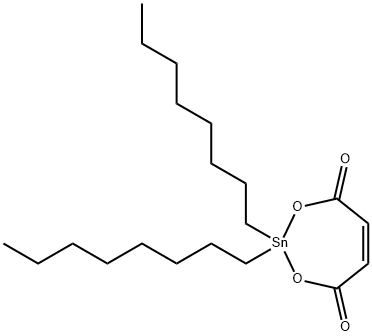
Dioctyl(maleate)tin
Product Availability
Choose a grade to view its available package options.
4 package records4 with current stock1 grade group
- Product code: starshine_CAS16091-18-2
- Purity/Analytical Methods: >99.0%
16091-18-2 / (Z)-but-2-enedioate;dioctyltin(2+)
Basic Information
CAS
16091-18-2
Multi CAS
No
Molecular Formula
C20H36O4Sn
Molecular Weight
459.200000
Exact Mass
460.163562
SMILES
CCCCCCCC[Sn+2]CCCCCCCC.C(=C\C(=O)[O-])\C(=O)[O-]
InChI
InChI=1S/2C8H17.C4H4O4.Sn/c2*1-3-5-7-8-6-4-2;5-3(6)1-2-4(7)8;/h2*1,3-8H2,2H3;1-2H,(H,5,6)(H,7,8);/q;;;+2/p-2
InChIKey
PZGVVCOOWYSSGB-UHFFFAOYSA-L
Physical Properties
Physical Description
Di(n-octyl)tin maleate is a white powder. (NTP, 1992)
State
Solid
Storage Conditions
STORAGE PRECAUTIONS: You should store this material in a refrigerator. (NTP, 1992)
Computed Properties
Structural Parameters
Heavy atom count
25
Fraction Csp3
0.8
Rotatable bonds
16
H-bond acceptors
4
Molar refractivity
101.27
TPSA
80.26
LogP / Solubility
WLOGP
3.29
MLOGP
2.93
XLogP3
3.29
Consensus LogP
3.17
Log S (ESOL)
-3.7
Class (ESOL)
Poorly soluble
Log S (Ali)
-5.7
Class (Ali)
Slightly soluble
Log S (SILICOS-IT)
-7.3
Class (SILICOS-IT)
Insoluble
ADME
GI absorption
High
BBB permeant
No
P-gp substrate
No
CYP1A2 inhibitor
No
CYP2C19 inhibitor
No
CYP2C9 inhibitor
No
CYP2D6 inhibitor
No
CYP3A4 inhibitor
Yes
Log Kp (skin permeation)
-3.18
Drug-likeness / Medicinal Chemistry
Lipinski
Yes
Ghose
Yes
Veber
No
Egan
Yes
Muegge
No
Bioavailability score
0.55
Brenk alerts
1
Leadlikeness
No
Synthetic Accessibility
2.5
Safety & Transport
Pictogram(s)
Irritant
Health Hazard
Signal
Danger
GHS Hazard Statements
H302 (65.5%): Harmful if swallowed [Warning Acute toxicity, oral]
H361 (25.9%): Suspected of damaging fertility or the unborn child [Warning Reproductive toxicity]
H372 (25.9%): Causes damage to organs through prolonged or repeated exposure [Danger Specific target organ toxicity, repeated exposure]
H412 (22.4%): Harmful to aquatic life with long lasting effects [Hazardous to the aquatic environment, long-term hazard]
H361d: Suspected of damaging the unborn child [Warning Reproductive toxicity]
Precautionary Statement Codes
P203, P260, P264, P270, P273, P280, P301+P317, P318, P319, P330, P405, and P501
P203, P260, P264, P270, P280, P318, P319, P405, and P501
Customers Also Viewed
-

-
-
-
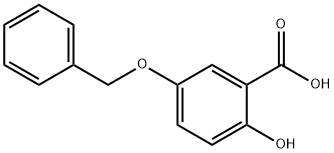
5-(benzyloxy)-2-hydroxybenzoic acid
- CAS RN: 16094-44-3
- Product Code: starshine_CAS16094-44-3
- Purity/Analytical method: >99.0%
-
-