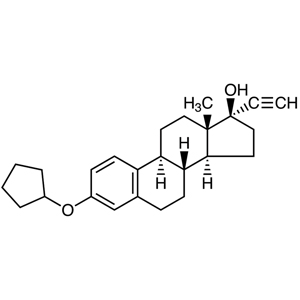
CAS RN: 152-43-2
Quinestrol
Product Availability
Choose a grade to view its available package options.
1 package records1 with current stock1 grade group
| Batch No. | Package | Availability | Warehouse | Inquiry |
|---|---|---|---|---|
| Batchno.20250712 | 25mg / 100mg / 250mg / 1g | Confirm by inquiry | Shanghai, Shandong | Inquiry |
- Product code: ICTQ0091
- Purity/Analytical Methods: >97.0%(T)(HPLC)
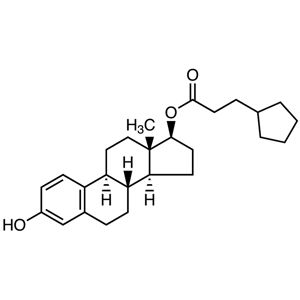
152-43-2 / (8R,9S,13S,14S,17R)-3-cyclopentyloxy-17-ethynyl-13-methyl-7,8,9,11,12,14,15,16-octahydro-6H-cyclopenta[a]phenanthren-17-ol
Basic Information
CAS
152-43-2
Multi CAS
No
Molecular Formula
C25H32O2
Molecular Weight
364.500000
Exact Mass
364.240230
SMILES
C[C@]12CC[C@H]3[C@H]([C@@H]1CC[C@]2(C#C)O)CCC4=C3C=CC(=C4)OC5CCCC5
InChI
InChI=1S/C25H32O2/c1-3-25(26)15-13-23-22-10-8-17-16-19(27-18-6-4-5-7-18)9-11-20(17)21(22)12-14-24(23,25)2/h1,9,11,16,18,21-23,26H,4-8,10,12-15H2,2H3/t21-,22-,23+,24+,25+/m1/s1
InChIKey
PWZUUYSISTUNDW-VAFBSOEGSA-N
Physical Properties
Melting Point
107.5 °C
Physical Description
Solid
State
Solid
Computed Properties
Structural Parameters
Heavy atom count
27
Aromatic heavy atom count
6
Fraction Csp3
0.68
Rotatable bonds
2
H-bond acceptors
2
H-bond donors
1
Molar refractivity
107.73
TPSA
29.46
LogP / Solubility
WLOGP
5.23
MLOGP
4.62
XLogP3
5.3
Consensus LogP
5.05
Log S (ESOL)
-5.43
Class (ESOL)
Slightly soluble
Log S (Ali)
-6.32
Class (Ali)
Insoluble
Log S (SILICOS-IT)
-6.61
Class (SILICOS-IT)
Insoluble
ADME
GI absorption
High
BBB permeant
No
P-gp substrate
No
CYP1A2 inhibitor
No
CYP2C19 inhibitor
No
CYP2C9 inhibitor
Yes
CYP2D6 inhibitor
No
CYP3A4 inhibitor
Yes
Log Kp (skin permeation)
-1.23
Drug-likeness / Medicinal Chemistry
Lipinski
Yes
Ghose
Yes
Veber
Yes
Egan
Yes
Muegge
No
Bioavailability score
0.55
Brenk alerts
1
Leadlikeness
No
Synthetic Accessibility
6
Safety & Transport
Pictogram(s)
Irritant
Health Hazard
Signal
Danger
GHS Hazard Statements
H302 (60.9%): Harmful if swallowed [Warning Acute toxicity, oral]
H312 (60.9%): Harmful in contact with skin [Warning Acute toxicity, dermal]
H332 (60.9%): Harmful if inhaled [Warning Acute toxicity, inhalation]
H350 (60.9%): May cause cancer [Danger Carcinogenicity]
H351 (39.1%): Suspected of causing cancer [Warning Carcinogenicity]
Precautionary Statement Codes
P203, P260, P261, P263, P264, P270, P271, P280, P301+P317, P302+P352, P304+P340, P317, P318, P321, P330, P362+P364, P405, and P501