CAS RN: 133-07-3
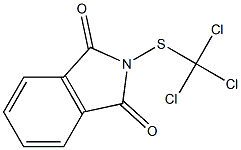
N-(Trichloromethylthio)phthalimide solution, 10μg/ml,u=6%
- Product code: SSC-039662
Historical Factory Record
Historical Supply Reference
This product has historical factory records. Recorded pack sizes and purity can be used as a supply reference, while project-specific availability is confirmed by inquiry.
- Pack sizes on record: 500g
- Available purity: ≥95%
- Inventory rows with stock: 0
- Bulk packaging: confirmed by inquiry
Reference Pack Sizes
Reference pack sizes are shown below. Final availability, packaging and delivery schedule are confirmed by inquiry.
| Pack Size | Recorded Purity | Available Qty | Ship From | Inquiry |
|---|---|---|---|---|
| 500g | ≥95% | 0 Out of Stock | Beijing | Inquiry |
133-07-3 / 2-(trichloromethylsulfanyl)isoindole-1,3-dione
Basic Information
CAS
133-07-3
Multi CAS
No
Molecular Formula
C9H4Cl3NO2S
Molecular Weight
296.600000
Exact Mass
294.902833
SMILES
C1=CC=C2C(=C1)C(=O)N(C2=O)SC(Cl)(Cl)Cl
InChI
InChI=1S/C9H4Cl3NO2S/c10-9(11,12)16-13-7(14)5-3-1-2-4-6(5)8(13)15/h1-4H
InChIKey
HKIOYBQGHSTUDB-UHFFFAOYSA-N
Physical Properties
Melting Point
177 °C
350.6
Density
1.72 at 20 °C
Physical Description
Folpet appears as white crystals. Used as a fungicide. Insoluble in water.
Colorless or white solid; [HSDB] White solid; Technical product is off-white to tan solid; [Reference #2]
Solid
WHITE CRYSTALS.
White crystals.
Appearance
Crystals from benzene
Light colored powder
Colorless crystals
White crystals
State
Solid
Storage Conditions
Provision to contain effluent from fire extinguishing. Store in an area without drain or sewer access. Separated from food and feedstuffs.
Store in dry place at ambient or lower temperatures.
Store in a cool, dry ventilated place. Protect from excessive heat. Keep locked up. Keep containers tightly closed. Keep only in the original container in ... Keep containers dry. To prevent contamination, store this product away from food or feed. Keep away from heat, fire and sparks.. /Folpan 80 WDG Fungicide/
Safe Storage of Pesticides. Always store pesticides in their original containers, complete with labels that list ingredients, directions for use, and first aid steps in case of accidental poisoning. Never store pesticides in cabinets with or near food, animal feed, or medical supplies. Do not store pesticides in places where flooding is possible or in places where they might spill or leak into wells, drains, ground water, or surface water. /Residential users/
PRECAUTIONS FOR "CARCINOGENS": Storage site should be as close as practical to lab in which carcinogens are to be used, so that only small quantities required for ... expt need to be carried. Carcinogens should be kept in only one section of cupboard, an explosion-proof refrigerator or freezer (depending on chemicophysical properties ...) that bears appropriate label. An inventory ... should be kept, showing quantity of carcinogen & date it was acquired ... Facilities for dispensing ... should be contiguous to storage area. /Chemical Carcinogens/
Computed Properties
Structural Parameters
Heavy atom count
16
Aromatic heavy atom count
6
Fraction Csp3
0.11
Rotatable bonds
1
H-bond acceptors
3
Molar refractivity
64.82
TPSA
37.38
LogP / Solubility
WLOGP
3.26
MLOGP
2.88
XLogP3
2.8
Consensus LogP
2.98
Log S (ESOL)
-3.94
Class (ESOL)
Poorly soluble
Log S (Ali)
-4.34
Class (Ali)
Slightly soluble
Log S (SILICOS-IT)
-4.41
Class (SILICOS-IT)
Slightly soluble
ADME
GI absorption
High
BBB permeant
Yes
P-gp substrate
No
CYP1A2 inhibitor
No
CYP2C19 inhibitor
No
CYP2C9 inhibitor
No
CYP2D6 inhibitor
Yes
CYP3A4 inhibitor
No
Log Kp (skin permeation)
-2.22
Drug-likeness / Medicinal Chemistry
Lipinski
Yes
Ghose
No
Veber
Yes
Egan
Yes
Muegge
Yes
Bioavailability score
0.55
Brenk alerts
1
Leadlikeness
Yes
Synthetic Accessibility
1.5
Safety & Transport
Pictogram(s)
Irritant
Health Hazard
Environmental Hazard
Acute Toxic
Signal
Warning
Danger
GHS Hazard Statements
H317: May cause an allergic skin reaction [Warning Sensitization, Skin]
H319: Causes serious eye irritation [Warning Serious eye damage/eye irritation]
H332: Harmful if inhaled [Warning Acute toxicity, inhalation]
H351: Suspected of causing cancer [Warning Carcinogenicity]
H400: Very toxic to aquatic life [Warning Hazardous to the aquatic environment, acute hazard]
Precautionary Statement Codes
P203, P261, P264+P265, P271, P272, P273, P280, P302+P352, P304+P340, P305+P351+P338, P317, P318, P321, P333+P317, P337+P317, P362+P364, P391, P405, and P501
P260, P264, P264+P265, P270, P273, P280, P305+P351+P338, P319, P337+P317, P391, and P501
P203, P260, P261, P271, P272, P280, P284, P302+P352, P304+P340, P316, P318, P320, P321, P333+P317, P362+P364, P403+P233, P405, and P501
Hazard Class/Division
9
Packing Group
III
Customers Also Viewed
-

ASARININ
- CAS RN: 133-04-0
- Product Code: starshine_CAS133-04-0
- Purity/Analytical method: >99.0%
-
(-)-ASARININ 97
- CAS RN: 133-05-1
- Product Code: starshine_CAS133-05-1
- Purity/Analytical method: >99.0%
-
-
-
-