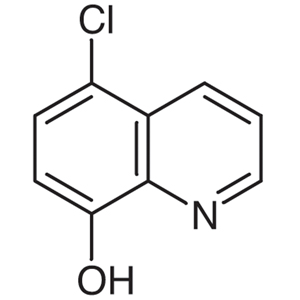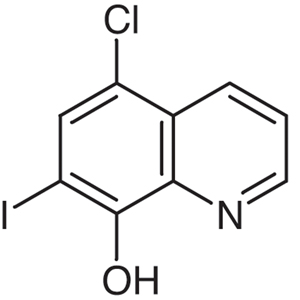
CAS RN: 130-26-7
5-Chloro-8-hydroxy-7-iodoquinoline
Product Availability
Choose a grade to view its available package options.
5 package records5 with current stock2 grade groups
- Product code: SSC-036738
Historical Factory Record
Historical Supply Reference
This product has historical factory records. Recorded pack sizes and purity can be used as a supply reference, while project-specific availability is confirmed by inquiry.
- Pack sizes on record: 25g
- Available purity: ≥97%
- Inventory rows with stock: 0
- Bulk packaging: confirmed by inquiry
Reference Pack Sizes
Reference pack sizes are shown below. Final availability, packaging and delivery schedule are confirmed by inquiry.
| Pack Size | Recorded Purity | Available Qty | Ship From | Inquiry |
|---|---|---|---|---|
| 25g | ≥97% | 0 Out of Stock | Hong Kong | Inquiry |
130-26-7 / 5-chloro-7-iodoquinolin-8-ol
Basic Information
CAS
130-26-7
Multi CAS
No
Molecular Formula
C9H5ClINO
Molecular Weight
305.500000
Exact Mass
304.910440
SMILES
C1=CC2=C(C(=C(C=C2Cl)I)O)N=C1
InChI
InChI=1S/C9H5ClINO/c10-6-4-7(11)9(13)8-5(6)2-1-3-12-8/h1-4,13H
InChIKey
QCDFBFJGMNKBDO-UHFFFAOYSA-N
Physical Properties
Melting Point
352 to 354 °F (NTP, 1992)
178-179 °C
Physical Description
Iodochlorohydroxyquinoline is a cream-colored to brownish-yellow powder. Practically odorless. Decomposes at 178-179 °C. Used as a topical anti-infective.
Appearance
Brownish-yellow, bulky powder
Yellow brown needles from alcohol, acetic acid.
A voluminous, spongy, yellowish to white brownish powder
State
Solid
Storage Conditions
STORAGE PRECAUTIONS: You should protect this material from exposure to light, and store it under ambient temperatures. (NTP, 1992)
Computed Properties
Structural Parameters
Heavy atom count
13
Aromatic heavy atom count
10
H-bond acceptors
2
H-bond donors
1
Molar refractivity
61.13
TPSA
33.12
LogP / Solubility
WLOGP
3.2
MLOGP
2.83
XLogP3
3.5
Consensus LogP
3.18
Log S (ESOL)
-4.32
Class (ESOL)
Slightly soluble
Log S (Ali)
-4.37
Class (Ali)
Slightly soluble
Log S (SILICOS-IT)
-4.3
Class (SILICOS-IT)
Slightly soluble
ADME
GI absorption
High
BBB permeant
Yes
P-gp substrate
No
CYP1A2 inhibitor
Yes
CYP2C19 inhibitor
Yes
CYP2C9 inhibitor
Yes
CYP2D6 inhibitor
No
CYP3A4 inhibitor
No
Log Kp (skin permeation)
-2.31
Drug-likeness / Medicinal Chemistry
Lipinski
Yes
Ghose
No
Veber
Yes
Egan
Yes
Muegge
Yes
Bioavailability score
0.55
Brenk alerts
1
Leadlikeness
Yes
Synthetic Accessibility
1.5
Safety & Transport
Pictogram(s)
Acute Toxic
Irritant
Health Hazard
Environmental Hazard
Signal
Danger
GHS Hazard Statements
H301 (41.5%): Toxic if swallowed [Danger Acute toxicity, oral]
H315 (69.4%): Causes skin irritation [Warning Skin corrosion/irritation]
H319 (69.4%): Causes serious eye irritation [Warning Serious eye damage/eye irritation]
H335 (54.4%): May cause respiratory irritation [Warning Specific target organ toxicity, single exposure; Respiratory tract irritation]
H361fd (11.6%): Suspected of damaging fertility; Suspected of damaging the unborn child [Warning Reproductive toxicity]
Precautionary Statement Codes
P203, P260, P261, P264, P264+P265, P270, P271, P273, P280, P301+P316, P302+P352, P304+P340, P305+P351+P338, P318, P319, P321, P330, P332+P317, P337+P317, P362+P364, P391, P403+P233, P405, and P501
Customers Also Viewed
-

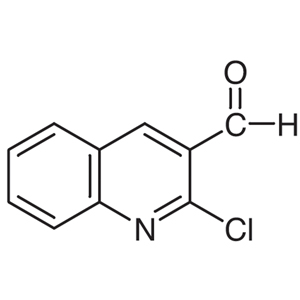
2-Chloro-3-quinolinecarboxaldehyde
- CAS RN: 73568-25-9
- Product Code: ICTC2289
- Purity/Analytical method: >98.0%(GC)
-
-
-
-
-