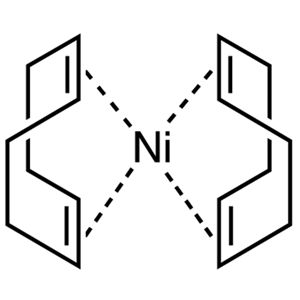
CAS RN: 1295-35-8
Bis(1,5-cyclooctadiene)nickel(0) (Wax encapsulated) (ca. 0.05mmol/capsule)
Product Availability
Choose a grade to view its available package options.
4 package records3 with current stock2 grade groups
- Product code: ICTB5417
1295-35-8 / bis((1Z,5Z)-cycloocta-1,5-diene);nickel
Basic Information
CAS
1295-35-8
Multi CAS
No
Molecular Formula
C16H24Ni
Molecular Weight
275.050000
Exact Mass
274.123142
SMILES
C1/C=C\CC/C=C\C1.C1/C=C\CC/C=C\C1.[Ni]
InChI
InChI=1S/2C8H12.Ni/c2*1-2-4-6-8-7-5-3-1;/h2*1-2,7-8H,3-6H2;/b2*2-1-,8-7-;
InChIKey
JRTIUDXYIUKIIE-KZUMESAESA-N
Physical Properties
Melting Point
284 to 288 °F (NTP, 1992)
Boiling Point
Decomposes (NTP, 1992)
Physical Description
Bis(1,5-cyclooctadiene)nickel appears as yellow crystals or yellowish green solid. (NTP, 1992)
Yellow or yellowish-green solid; [CAMEO] Yellow crystalline solid
State
Solid
Storage Conditions
STORAGE PRECAUTIONS: You should protect this chemical from exposure to light. Keep the container tightly closed under an inert atmosphere, and store it in a freezer. All handling of this compound should be done under an inert atmosphere. (NTP, 1992)
Computed Properties
Structural Parameters
Heavy atom count
17
Fraction Csp3
0.5
Molar refractivity
73.5
TPSA
0.0000
LogP / Solubility
WLOGP
5.34
MLOGP
4.71
XLogP3
5.34
Consensus LogP
5.13
Log S (ESOL)
-4.91
Class (ESOL)
Slightly soluble
Log S (Ali)
-5.67
Class (Ali)
Slightly soluble
Log S (SILICOS-IT)
-5.88
Class (SILICOS-IT)
Slightly soluble
ADME
GI absorption
High
BBB permeant
No
P-gp substrate
No
CYP1A2 inhibitor
No
CYP2C19 inhibitor
No
CYP2C9 inhibitor
No
CYP2D6 inhibitor
No
CYP3A4 inhibitor
No
Log Kp (skin permeation)
-0.6
Drug-likeness / Medicinal Chemistry
Lipinski
Yes
Ghose
No
Veber
Yes
Egan
Yes
Muegge
No
Bioavailability score
0.55
Brenk alerts
1
Leadlikeness
No
Synthetic Accessibility
1.5
Safety & Transport
Pictogram(s)
Flammable
Irritant
Health Hazard
Signal
Danger
GHS Hazard Statements
H228 (100%): Flammable solid [Danger Flammable solids]
H317 (16.3%): May cause an allergic skin reaction [Warning Sensitization, Skin]
H334 (79.6%): May cause allergy or asthma symptoms or breathing difficulties if inhaled [Danger Sensitization, respiratory]
H350 (20.4%): May cause cancer [Danger Carcinogenicity]
H351 (77.6%): Suspected of causing cancer [Warning Carcinogenicity]
Precautionary Statement Codes
P203, P210, P233, P240, P241, P260, P261, P271, P272, P280, P284, P302+P352, P304+P340, P318, P321, P333+P317, P342+P316, P362+P364, P370+P378, P403, P405, and P501
Customers Also Viewed
-

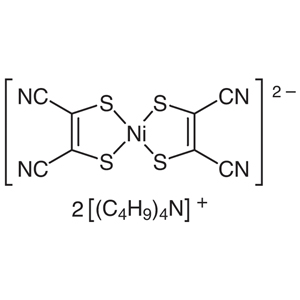
Bis(tetrabutylammonium) Bis(maleonitriledithiolato)nickel(II) Complex
- CAS RN: 18958-57-1
- Product Code: SSC-088713
-
-
-
-
[1,3-Bis(2,6-diisopropylphenyl)imidazol-2-ylidene]triphenylphosphine Nickel(II) Dichloride
- CAS RN: 903592-98-3
- Product Code: SSC-202858
-
![CAS 38951-97-2 Bis[4,4′-dimethoxy(dithiobenzil)]nickel(II) molecular structure](https://starshinechemical.com/wp-content/uploads/2022/03/b4360-jpgcontextbwfzdgvyfhjvb3r8mzuzndb8aw1hz2uvanblz3xoyzqvadyzlzg5mjkwndy4odg0nzgvqjqznjauanbnfgqxmtvkyzm0nddiy2y0zwiymjdmzdnjytk5ntu3y2vmzgq1mdrindnizthhmdrmy2e3ntgzyjc5mwyzngvmywi.jpeg)
![CAS 903592-98-3 [1,3-Bis(2,6-diisopropylphenyl)imidazol-2-ylidene]triphenylphosphine Nickel(II) Dichloride molecular structure](https://starshinechemical.com/wp-content/uploads/2022/03/b3235-jpgcontextbwfzdgvyfhjvb3r8nde0odl8aw1hz2uvanblz3xomwevagq2lzg5mjg5mji3njmyotqvqjmymzuuanbnfdiyndk3zddlyzgwndbjyzbingmzytlmngixnjawywq1nzzkzdm5mta3yjaxyte5yjc4otnjogm5mtc1mzi0mtm.jpeg)