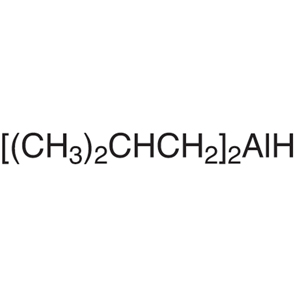
CAS RN: 1191-15-7
Diisobutylaluminum Hydride (19% in Hexane, ca. 1.0mol/L)
Product Availability
Choose a grade to view its available package options.
4 package records4 with current stock1 grade group
- Product code: ICTD2971
1191-15-7 / bis(2-methylpropyl)alumane
Dibal-H | bis(2-methylpropyl)alumane | Diisobutylhydroaluminum
Basic Information
CAS
1191-15-7
Multi CAS
Yes
Molecular Formula
C8H19Al
Molecular Weight
142.220000
Exact Mass
142.130214
SMILES
CC(C)C[AlH]CC(C)C
InChI
InChI=1S/2C4H9.Al.H/c2*1-4(2)3;;/h2*4H,1H2,2-3H3;;
InChIKey
AZWXAPCAJCYGIA-UHFFFAOYSA-N
Synonyms
Dibal-H
bis(2-methylpropyl)alumane
Diisobutylhydroaluminum
Al-Diisobutyl
Al-Alchili
Physical Properties
Melting Point
-80 °C (Freezing point)
Boiling Point
105 °C @ 0.2 mm Hg
Density
0.798 g/mL
Physical Description
Liquid
Colorless liquid; [Hawley]
Appearance
Colorless liquid
State
Liquid
Storage Conditions
Separate from air, water, halocarbons, alcohols. Store in a cool, dry, well-ventilated location. Outside or detached storage is preferred. Inside storage should be in a standard flammable liquid storage warehouse, room, or cabinet. /Aluminum alkyls/
Computed Properties
Structural Parameters
Heavy atom count
9
Fraction Csp3
1
Rotatable bonds
4
Molar refractivity
46.44
TPSA
0.0000
LogP / Solubility
WLOGP
2.57
MLOGP
2.26
XLogP3
2.57
Consensus LogP
2.47
Log S (ESOL)
-2.08
Class (ESOL)
Moderately soluble
Log S (Ali)
-2.58
Class (Ali)
Moderately soluble
Log S (SILICOS-IT)
-3.2
Class (SILICOS-IT)
Poorly soluble
ADME
GI absorption
High
BBB permeant
Yes
P-gp substrate
No
CYP1A2 inhibitor
No
CYP2C19 inhibitor
No
CYP2C9 inhibitor
No
CYP2D6 inhibitor
No
CYP3A4 inhibitor
No
Log Kp (skin permeation)
-1.76
Drug-likeness / Medicinal Chemistry
Lipinski
Yes
Ghose
No
Veber
Yes
Egan
Yes
Muegge
No
Bioavailability score
0.55
Leadlikeness
No
Synthetic Accessibility
1.5
Safety & Transport
Pictogram(s)
Flammable
Corrosive
Signal
Danger
GHS Hazard Statements
H250 (97.7%): Catches fire spontaneously if exposed to air [Danger Pyrophoric liquids]
H260 (93.1%): In contact with water releases flammable gases which may ignite spontaneously [Danger Substances and mixtures which in contact with water, emit flammable gases]
H314 (100%): Causes severe skin burns and eye damage [Danger Skin corrosion/irritation]
H318 (83.2%): Causes serious eye damage [Danger Serious eye damage/eye irritation]
Precautionary Statement Codes
P210, P222, P223, P231, P231+P232, P233, P260, P264, P264+P265, P280, P301+P330+P331, P302+P335+P334, P302+P361+P354, P304+P340, P305+P354+P338, P316, P317, P321, P363, P370+P378, P402+P404, P405, and P501
DOT ID (UN/NA Number)
3051
Customers Also Viewed
-

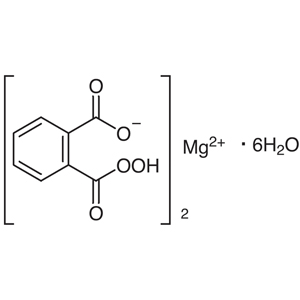
Monoperoxyphthalic Acid Magnesium Salt Hexahydrate
- CAS RN: 84665-66-7
- Product Code: ICTM0927
- Purity/Analytical method: >65.0%(T)
-
-
-
-
-