Verified Factory Data
Supply Overview & Packaging Options
Packaging options, recorded purity, stock quantity and ship-from location below are generated from the current factory data table for this CAS.
- Pack sizes on record: 500g, 1000g, 25g, 100g
- Available purity: ≥98%
- Inventory rows with stock: 4
- Bulk packaging: confirmed by inquiry
Available Pack Sizes & Stock
Specific stock quantities are shown below. Price is not displayed online and is confirmed by inquiry.
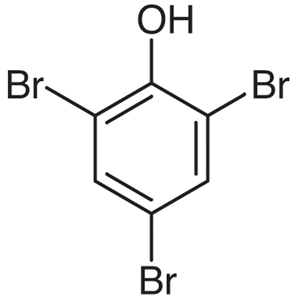
118-79-6 / 2,4,6-tribromophenol
2,4,6-tribromophenol | Bromol | Bromkal pur 3
Basic Information
CAS
118-79-6
Multi CAS
Yes
Molecular Formula
C6H3Br3O
Molecular Weight
330.800000
Exact Mass
329.771350
SMILES
C1=C(C=C(C(=C1Br)O)Br)Br
InChI
InChI=1S/C6H3Br3O/c7-3-1-4(8)6(10)5(9)2-3/h1-2,10H
InChIKey
BSWWXRFVMJHFBN-UHFFFAOYSA-N
Synonyms
2,4,6-tribromophenol
Bromol
Bromkal pur 3
Flammex 3BP
Phenol, 2,4,6-tribromo-
Physical Properties
Melting Point
203 to 205 °F (NTP, 1992)
94-96 °C
87 - 89 °C
95.5 °C
Boiling Point
471 °F at 760 mmHg (Sublimes at 540-554 °F at 764 mmHg) (NTP, 1992)
286 °C
Density
2.55 at 68 °F (NTP, 1992) - Denser than water; will sink
2.55 g/cu cm at 20 °C
2.55 g/cm³
Physical Description
Soft, long, white crystals with a bromine odor. (NTP, 1992)
Pellets or Large Crystals
White solid with an odor of bromine; [Hawley] White to pink solid; [ICSC] Off-white or pink flakes;
Solid
WHITE-TO-PINK POWDER.
Appearance
Needles from alcohol; prisms from benzene
Long crystals
Soft, white needles
State
Solid
Storage Conditions
STORAGE PRECAUTIONS: You should store this material in a refrigerator. (NTP, 1992)
Computed Properties
Structural Parameters
Heavy atom count
10
Aromatic heavy atom count
6
H-bond acceptors
1
H-bond donors
1
Molar refractivity
51.21
TPSA
20.23
LogP / Solubility
WLOGP
3.68
MLOGP
3.25
XLogP3
4.4
Consensus LogP
3.78
Log S (ESOL)
-4.65
Class (ESOL)
Slightly soluble
Log S (Ali)
-4.93
Class (Ali)
Slightly soluble
Log S (SILICOS-IT)
-4.86
Class (SILICOS-IT)
Slightly soluble
ADME
GI absorption
High
BBB permeant
Yes
P-gp substrate
No
CYP1A2 inhibitor
No
CYP2C19 inhibitor
No
CYP2C9 inhibitor
Yes
CYP2D6 inhibitor
No
CYP3A4 inhibitor
No
Log Kp (skin permeation)
-2.13
Drug-likeness / Medicinal Chemistry
Lipinski
Yes
Ghose
No
Veber
Yes
Egan
Yes
Muegge
Yes
Bioavailability score
0.55
Leadlikeness
No
Synthetic Accessibility
1.5
Safety & Transport
Pictogram(s)
Irritant
Environmental Hazard
Health Hazard
Signal
Warning
GHS Hazard Statements
H317 (94.6%): May cause an allergic skin reaction [Warning Sensitization, Skin]
H319 (97.8%): Causes serious eye irritation [Warning Serious eye damage/eye irritation]
H400 (94.6%): Very toxic to aquatic life [Warning Hazardous to the aquatic environment, acute hazard]
H400: Very toxic to aquatic life [Warning Hazardous to the aquatic environment, acute hazard]
H410: Very toxic to aquatic life with long lasting effects [Warning Hazardous to the aquatic environment, long-term hazard]
Precautionary Statement Codes
P261, P264+P265, P272, P273, P280, P302+P352, P305+P351+P338, P321, P333+P317, P337+P317, P362+P364, P391, and P501
P273, P391, and P501
P203, P260, P261, P264, P264+P265, P270, P272, P280, P301+P317, P302+P352, P305+P351+P338, P308+P316, P318, P319, P321, P330, P333+P317, P337+P317, P362+P364, P405, and P501
Customers Also Viewed
-

-
-
-
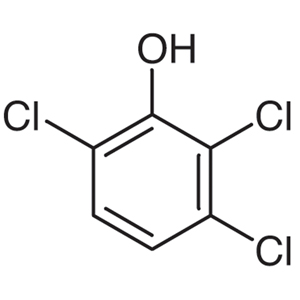
2,3,6-Trichlorophenol
- CAS RN: 933-75-5
- Product Code: ICTT1114
- Purity/Analytical method: >98.0%(GC)(T)
-
-