CAS RN: 115-32-2
Dicofol standard solution, 100μg/ml,u=5%
Product Availability
Choose a grade to view its available package options.
5 package records5 with current stock4 grade groups
- Product code: LIND807345
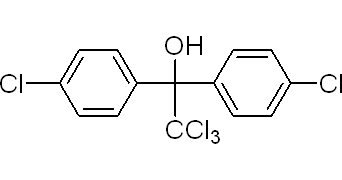
115-32-2 / 2,2,2-trichloro-1,1-bis(4-chlorophenyl)ethanol
DICOFOL | Kelthane | Acarin
Basic Information
CAS
115-32-2
Multi CAS
Yes
Molecular Formula
C14H9Cl5O
Molecular Weight
370.500000
Exact Mass
369.906653
SMILES
C1=CC(=CC=C1C(C2=CC=C(C=C2)Cl)(C(Cl)(Cl)Cl)O)Cl
InChI
InChI=1S/C14H9Cl5O/c15-11-5-1-9(2-6-11)13(20,14(17,18)19)10-3-7-12(16)8-4-10/h1-8,20H
InChIKey
UOAMTSKGCBMZTC-UHFFFAOYSA-N
Synonyms
DICOFOL
Kelthane
Acarin
Mitigan
Dichlorokelthane
Physical Properties
Melting Point
173.3 to 175.1 °F (NTP, 1992)
77.5 °C
77-78 °C
Boiling Point
437 °F at 760 mmHg (NTP, 1992)
180 °C at 0.1 mm Hg
Density
greater than 1.1 at 68 °F
Specific gravity: 1.130 at 20 °C
1.13 g/cm³
Physical Description
Dicofol or kelthane is a white crystalline, wettable powder dissolved in a liquid carrier, (water). The primary hazard is the threat to the environment. Immediate steps should be taken to limit its spread to the environment. Since it is a liquid it can easily penetrate the soil and contaminate groundwater and nearby streams. It can cause illness by inhalation, skin absorption, and/or ingestion. It is used as a pesticide.
Colorless solid; [ICSC] Colorless crystalline solid;
COLOURLESS CRYSTALS.
Appearance
Colorless solid
Crystals from petroleum ether
State
Solid
Storage Conditions
Store above 40 °F, away from feed, foodstuffs, or any body of water.
... Store in tightly closed containers in a cool, well ventilated area away from alkaline pesticides, strong acids, acid fumes, and steel ...
Computed Properties
Structural Parameters
Heavy atom count
20
Aromatic heavy atom count
12
Fraction Csp3
0.14
Rotatable bonds
2
H-bond acceptors
1
H-bond donors
1
Molar refractivity
86.19
TPSA
20.23
LogP / Solubility
WLOGP
5.6
MLOGP
4.95
XLogP3
4.3
Consensus LogP
4.95
Log S (ESOL)
-5.98
Class (ESOL)
Slightly soluble
Log S (Ali)
-6.64
Class (Ali)
Insoluble
Log S (SILICOS-IT)
-6.96
Class (SILICOS-IT)
Insoluble
ADME
GI absorption
High
BBB permeant
No
P-gp substrate
No
CYP1A2 inhibitor
Yes
CYP2C19 inhibitor
Yes
CYP2C9 inhibitor
Yes
CYP2D6 inhibitor
No
CYP3A4 inhibitor
Yes
Log Kp (skin permeation)
-1
Drug-likeness / Medicinal Chemistry
Lipinski
Yes
Ghose
Yes
Veber
Yes
Egan
Yes
Muegge
No
Bioavailability score
0.55
Brenk alerts
1
Leadlikeness
No
Synthetic Accessibility
1.5
Safety & Transport
Pictogram(s)
Irritant
Environmental Hazard
Health Hazard
Corrosive
Signal
Warning
Danger
GHS Hazard Statements
H302: Harmful if swallowed [Warning Acute toxicity, oral]
H312: Harmful in contact with skin [Warning Acute toxicity, dermal]
H315: Causes skin irritation [Warning Skin corrosion/irritation]
H317: May cause an allergic skin reaction [Warning Sensitization, Skin]
H400: Very toxic to aquatic life [Warning Hazardous to the aquatic environment, acute hazard]
Precautionary Statement Codes
P261, P264, P270, P272, P273, P280, P301+P317, P302+P352, P317, P321, P330, P332+P317, P333+P317, P362+P364, P391, and P501
P203, P260, P261, P264, P264+P265, P270, P271, P273, P280, P301+P317, P302+P352, P304+P340, P305+P351+P338, P308+P316, P318, P319, P321, P330, P332+P317, P337+P317, P362+P364, P391, P403+P233, P405, and P501
P260, P261, P264, P264+P265, P270, P272, P280, P301+P317, P302+P352, P305+P354+P338, P308+P316, P317, P319, P321, P330, P333+P317, P362+P364, P405, and P501
DOT ID (UN/NA Number)
2762
2761
2995
2996
Customers Also Viewed
-

AZASERINE
- CAS RN: 115-02-6
- Product Code: starshine_CAS115-02-6
- Purity/Analytical method: >99.0%
-
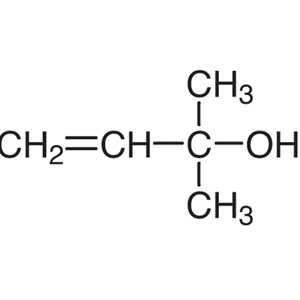
2-Methyl-3-buten-2-ol
- CAS RN: 115-18-4
- Product Code: ICTM0178
- Purity/Analytical method: >97.0%(GC)
-
-
-
-
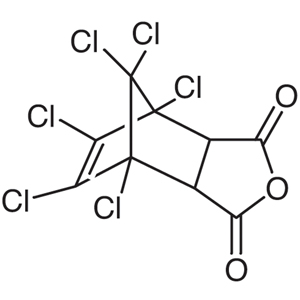
Chlorendic Acid
- CAS RN: 115-28-6
- Product Code: ICTH0054
- Purity/Analytical method: >98.0%(T)