Historical Factory Record
Historical Supply Reference
This product has historical factory records. Recorded pack sizes and purity can be used as a supply reference, while project-specific availability is confirmed by inquiry.
- Pack sizes on record: 500g
- Available purity: >97%
- Inventory rows with stock: 0
- Bulk packaging: confirmed by inquiry
Reference Pack Sizes
Reference pack sizes are shown below. Final availability, packaging and delivery schedule are confirmed by inquiry.
| Pack Size | Recorded Purity | Available Qty | Ship From | Inquiry |
|---|---|---|---|---|
| 500g | >97% | 0 Out of Stock | Hong Kong | Inquiry |
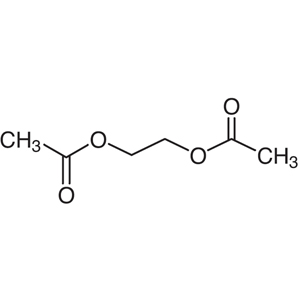
111-55-7 / 2-acetyloxyethyl acetate
ETHYLENE GLYCOL DIACETATE | Glycol diacetate | 1,2-Diacetoxyethane
Basic Information
CAS
111-55-7
Multi CAS
Yes
Molecular Formula
C6H10O4
Molecular Weight
146.140000
Exact Mass
146.057909
SMILES
CC(=O)OCCOC(=O)C
InChI
InChI=1S/C6H10O4/c1-5(7)9-3-4-10-6(2)8/h3-4H2,1-2H3
InChIKey
JTXMVXSTHSMVQF-UHFFFAOYSA-N
Synonyms
ETHYLENE GLYCOL DIACETATE
Glycol diacetate
1,2-Diacetoxyethane
Ethylene diacetate
1,2-Ethanediol diacetate
Physical Properties
Melting Point
-24 °F (NTP, 1992)
-31 °C
Boiling Point
367 to 369 °F at 760 mmHg (NTP, 1992)
190-191 °C
Density
1.104 at 68 °F (USCG, 1999) - Denser than water; will sink
1.104
Bulk density = 9.2 lb/gal at 20 °C, freezing point = -31 °C
Physical Description
Ethylene glycol diacetate is a colorless liquid with a mild pleasant odor. Density 9.2 lb /gal. Flash point 191 °F. Boiling point 369 °F. Combustible but requires some effort to ignite. Used in the manufacture of perfumes, printing ink, lacquers and resins.
Dry Powder; Liquid
Colorless liquid; [Hawley]
Appearance
COLORLESS LIQ
State
Solid
Storage Conditions
Storage temp: ambient; venting: open (flame arrester)
Computed Properties
Structural Parameters
Heavy atom count
10
Fraction Csp3
0.67
Rotatable bonds
3
H-bond acceptors
4
Molar refractivity
33.27
TPSA
52.6
LogP / Solubility
WLOGP
0.11
MLOGP
0.09
Consensus LogP
0.07
Log S (ESOL)
-0.62
Class (ESOL)
Very soluble
Log S (Ali)
-0.84
Class (Ali)
Very soluble
Log S (SILICOS-IT)
-1.06
Class (SILICOS-IT)
Soluble
ADME
GI absorption
High
BBB permeant
Yes
P-gp substrate
No
CYP1A2 inhibitor
No
CYP2C19 inhibitor
No
CYP2C9 inhibitor
No
CYP2D6 inhibitor
No
CYP3A4 inhibitor
No
Log Kp (skin permeation)
-3.53
Drug-likeness / Medicinal Chemistry
Lipinski
Yes
Ghose
No
Veber
Yes
Egan
Yes
Muegge
No
Bioavailability score
0.55
Brenk alerts
1
Leadlikeness
No
Synthetic Accessibility
1.5
Safety & Transport
Pictogram(s)
Irritant
Health Hazard
Signal
Warning
GHS Hazard Statements
H315 (14%): Causes skin irritation [Warning Skin corrosion/irritation]
H319 (29.5%): Causes serious eye irritation [Warning Serious eye damage/eye irritation]
H335 (10.1%): May cause respiratory irritation [Warning Specific target organ toxicity, single exposure; Respiratory tract irritation]
Not Classified
Reported as not meeting GHS hazard criteria by 92 of 92 companies. For more detailed information, please visit ECHA C&L website.
Precautionary Statement Codes
P261, P264, P264+P265, P271, P280, P302+P352, P304+P340, P305+P351+P338, P319, P321, P332+P317, P337+P317, P362+P364, P403+P233, P405, and P501
P260, P264, P264+P265, P273, P280, P302+P352, P305+P351+P338, P319, P321, P332+P317, P337+P317, P362+P364, and P501
Customers Also Viewed
-

-
-
-
-
Trimethylsilyl Acrylate (stabilized with BHT)
- CAS RN: 13688-55-6
- Product Code: ICTT3559
- Purity/Analytical method: >95.0%(GC)
-