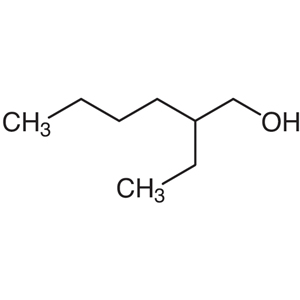
CAS RN: 104-76-7
2-Ethyl-1-hexanol
Product Availability
Choose a grade to view its available package options.
8 package records8 with current stock6 grade groups
| Batch No. | Package | Availability | Warehouse | Inquiry |
|---|---|---|---|---|
| Batchno.20260513 | 500ml / 2.5L / 10L | Confirm by inquiry | Shanghai, Shandong, Guangdong, Chongqing, Hebei | Inquiry |
| Batch No. | Package | Availability | Warehouse | Inquiry |
|---|---|---|---|---|
| Batchno.20250926 | 5ml | In stock | Inquiry |
| Batch No. | Package | Availability | Warehouse | Inquiry |
|---|---|---|---|---|
| Batchno.20260217 | 500ml / 2.5L / 10L / 12X500ml | Confirm by inquiry | Shanghai, Shandong, Guangdong, Chongqing, Hebei | Inquiry |
| Batch No. | Package | Availability | Warehouse | Inquiry |
|---|---|---|---|---|
| Batchno.20250604 | 5ml | In stock | Shanghai, Shandong, Guangdong, Chongqing, Hebei | Inquiry |
| Batch No. | Package | Availability | Warehouse | Inquiry |
|---|---|---|---|---|
| Batchno.20250622 | 5ml | In stock | Inquiry |
- Product code: SSC-005748
Historical Factory Record
Historical Supply Reference
This product has historical factory records. Recorded pack sizes and purity can be used as a supply reference, while project-specific availability is confirmed by inquiry.
- Pack sizes on record: 500ml
- Available purity: ≥95%
- Inventory rows with stock: 0
- Bulk packaging: confirmed by inquiry
Reference Pack Sizes
Reference pack sizes are shown below. Final availability, packaging and delivery schedule are confirmed by inquiry.
| Pack Size | Recorded Purity | Available Qty | Ship From | Inquiry |
|---|---|---|---|---|
| 500ml | ≥95% | 0 Out of Stock | Shenzhen | Inquiry |
104-76-7 / 2-ethylhexan-1-ol
2-Ethylhexan-1-ol | 2-Ethylhexanol | 2-ETHYL-1-HEXANOL
Basic Information
CAS
104-76-7
Multi CAS
Yes
Molecular Formula
C8H18O
Molecular Weight
130.230000
Exact Mass
130.135765
SMILES
CCCCC(CC)CO
InChI
InChI=1S/C8H18O/c1-3-5-6-8(4-2)7-9/h8-9H,3-7H2,1-2H3
InChIKey
YIWUKEYIRIRTPP-UHFFFAOYSA-N
Synonyms
2-Ethylhexan-1-ol
2-Ethylhexanol
2-ETHYL-1-HEXANOL
2-Ethylhexyl alcohol
1-Hexanol, 2-ethyl-
Physical Properties
Melting Point
-105 °F (NTP, 1992)
-70 °C
-76.00 °C. @ 760.00 mm Hg
-105 °F
Boiling Point
363 to 365 °F at 760 mmHg (NTP, 1992)
184.34 °C
184.00 to 186.00 °C. @ 760.00 mm Hg
182 °C
363-365 °F
Density
0.834 at 68 °F (USCG, 1999) - Less dense than water; will float
0.8344 at 20 °C/20 °C
Bulk density: 6.9 lb/gal at 20 °C
% IN SATURATED AIR: 0.0066 @ 20 °C; DENSITY OF "SATURATED" AIR: LESS THAN 1.001 (AIR= 1)
Relative density (water = 1): 0.83
Physical Description
2-ethyl hexanol appears as a dark brown liquid with an aromatic odor. Insoluble in water and less dense than water. Flash point between 140 - 175 °F. Contact may irritate skin, eyes and mucous membranes. May be toxic by ingestion, inhalation and skin absorption.
Liquid; Water or Solvent Wet Solid
Colorless liquid; [Merck Index]
COLOURLESS LIQUID WITH CHARACTERISTIC ODOUR.
colourless to pale yellow liquid
Appearance
Colorless liquid
State
Solid
Storage Conditions
Separated from strong oxidants and strong bases. Store in an area without drain or sewer access. Ventilation along the floor.
Computed Properties
Structural Parameters
Heavy atom count
9
Fraction Csp3
1
Rotatable bonds
5
H-bond acceptors
1
H-bond donors
1
Molar refractivity
40.39
TPSA
20.23
LogP / Solubility
WLOGP
2.2
MLOGP
1.92
XLogP3
3.1
Consensus LogP
2.41
Log S (ESOL)
-1.7
Class (ESOL)
Soluble
Log S (Ali)
-2.21
Class (Ali)
Moderately soluble
Log S (SILICOS-IT)
-2.93
Class (SILICOS-IT)
Moderately soluble
ADME
GI absorption
High
BBB permeant
Yes
P-gp substrate
No
CYP1A2 inhibitor
No
CYP2C19 inhibitor
No
CYP2C9 inhibitor
No
CYP2D6 inhibitor
No
CYP3A4 inhibitor
No
Log Kp (skin permeation)
-1.96
Drug-likeness / Medicinal Chemistry
Lipinski
Yes
Ghose
No
Veber
Yes
Egan
Yes
Muegge
No
Bioavailability score
0.55
Leadlikeness
No
Synthetic Accessibility
2
Safety & Transport
Pictogram(s)
Irritant
Health Hazard
Corrosive
Signal
Warning
Danger
GHS Hazard Statements
H315 (88.6%): Causes skin irritation [Warning Skin corrosion/irritation]
H319 (98.7%): Causes serious eye irritation [Warning Serious eye damage/eye irritation]
H332 (71.2%): Harmful if inhaled [Warning Acute toxicity, inhalation]
H335 (72.5%): May cause respiratory irritation [Warning Specific target organ toxicity, single exposure; Respiratory tract irritation]
H402: Harmful to aquatic life [Hazardous to the aquatic environment, acute hazard]
Precautionary Statement Codes
P261, P264, P264+P265, P271, P280, P302+P352, P304+P340, P305+P351+P338, P317, P319, P321, P332+P317, P337+P317, P362+P364, P403+P233, P405, and P501
P273, and P501
P203, P210, P260, P261, P264, P264+P265, P270, P271, P273, P280, P302+P352, P304+P340, P305+P351+P338, P308+P316, P318, P319, P321, P332+P317, P337+P317, P362+P364, P370+P378, P403, P403+P233, P405, and P501
P203, P210, P261, P264, P264+P265, P271, P280, P302+P352, P304+P340, P305+P351+P338, P317, P318, P319, P321, P332+P317, P337+P317, P362+P364, P370+P378, P403, P403+P233, P405, and P501
P203, P260, P261, P264, P271, P280, P301+P330+P331, P302+P361+P354, P304+P340, P305+P354+P338, P316, P317, P318, P321, P363, P405, and P501