Historical Factory Record
Historical Supply Reference
This product has historical factory records. Recorded pack sizes and purity can be used as a supply reference, while project-specific availability is confirmed by inquiry.
- Pack sizes on record: 500g
- Available purity: >97%
- Inventory rows with stock: 0
- Bulk packaging: confirmed by inquiry
Reference Pack Sizes
Reference pack sizes are shown below. Final availability, packaging and delivery schedule are confirmed by inquiry.
| Pack Size | Recorded Purity | Available Qty | Ship From | Inquiry |
|---|---|---|---|---|
| 500g | >97% | 0 Out of Stock | Hong Kong | Inquiry |
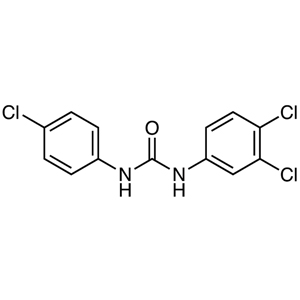
101-20-2 / 1-(4-chlorophenyl)-3-(3,4-dichlorophenyl)urea
Triclocarban | 1-(4-Chlorophenyl)-3-(3,4-dichlorophenyl)urea | 3,4,4'-TRICHLOROCARBANILIDE
Basic Information
CAS
101-20-2
Multi CAS
Yes
Molecular Formula
C13H9Cl3N2O
Molecular Weight
315.600000
Exact Mass
313.978046
SMILES
C1=CC(=CC=C1NC(=O)NC2=CC(=C(C=C2)Cl)Cl)Cl
InChI
InChI=1S/C13H9Cl3N2O/c14-8-1-3-9(4-2-8)17-13(19)18-10-5-6-11(15)12(16)7-10/h1-7H,(H2,17,18,19)
InChIKey
ICUTUKXCWQYESQ-UHFFFAOYSA-N
Synonyms
Triclocarban
1-(4-Chlorophenyl)-3-(3,4-dichlorophenyl)urea
3,4,4'-TRICHLOROCARBANILIDE
Cutisan
Procutene
Physical Properties
Melting Point
482 to 493 °F (NTP, 1992)
491.2- 493
254.4 °C
MP: 255.2-256 °C
Boiling Point
250 °C at 97.8 kPa (733 mm Hg)
Density
0.336 g/cu cm at 20 °C
Physical Description
Triclocarban appears as fine white plates or white powder. (NTP, 1992)
White solid; [Merck Index]
Appearance
Fine white plates
Fine plates
Fine, white to off-white powder
State
Solid
Storage Conditions
STORAGE PRECAUTIONS: You should store this material in a refrigerator. (NTP, 1992)
Computed Properties
Structural Parameters
Heavy atom count
19
Aromatic heavy atom count
12
Rotatable bonds
2
H-bond acceptors
1
H-bond donors
2
Molar refractivity
80.56
TPSA
41.13
LogP / Solubility
WLOGP
5.29
MLOGP
4.67
XLogP3
5.3
Consensus LogP
5.09
Log S (ESOL)
-5.47
Class (ESOL)
Slightly soluble
Log S (Ali)
-5.97
Class (Ali)
Slightly soluble
Log S (SILICOS-IT)
-6.34
Class (SILICOS-IT)
Insoluble
ADME
GI absorption
High
BBB permeant
No
P-gp substrate
No
CYP1A2 inhibitor
Yes
CYP2C19 inhibitor
Yes
CYP2C9 inhibitor
Yes
CYP2D6 inhibitor
Yes
CYP3A4 inhibitor
No
Log Kp (skin permeation)
-0.89
Drug-likeness / Medicinal Chemistry
Lipinski
Yes
Ghose
No
Veber
Yes
Egan
Yes
Muegge
No
Bioavailability score
0.55
Leadlikeness
No
Synthetic Accessibility
1.5
Safety & Transport
Pictogram(s)
Environmental Hazard
Signal
Warning
GHS Hazard Statements
H400 (96.8%): Very toxic to aquatic life [Warning Hazardous to the aquatic environment, acute hazard]
H410 (100%): Very toxic to aquatic life with long lasting effects [Warning Hazardous to the aquatic environment, long-term hazard]
H400: Very toxic to aquatic life [Warning Hazardous to the aquatic environment, acute hazard]
H410: Very toxic to aquatic life with long lasting effects [Warning Hazardous to the aquatic environment, long-term hazard]
Precautionary Statement Codes
P273, P391, and P501