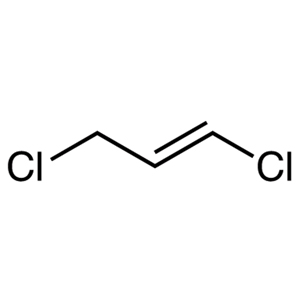
CAS RN: 10061-02-6
trans-1,3-Dichloropropene
Product Availability
Choose a grade to view its available package options.
1 package records1 with current stock1 grade group
| Batch No. | Package | Availability | Inquiry |
|---|---|---|---|
| Batchno.20260226 | 1ml | In stock | Inquiry |
- Product code: ICTD2346
- Purity/Analytical Methods: >98.0%(GC)
10061-02-6 / (E)-1,3-dichloroprop-1-ene
trans-1,3-Dichloropropene | (E)-1,3-Dichloropropene | (E)-1,3-Dichloro-1-propene
Basic Information
CAS
10061-02-6
Multi CAS
Yes
Molecular Formula
C3H4Cl2
Molecular Weight
110.970000
Exact Mass
109.969006
SMILES
C(/C=C/Cl)Cl
InChI
InChI=1S/C3H4Cl2/c4-2-1-3-5/h1-2H,3H2/b2-1+
InChIKey
UOORRWUZONOOLO-OWOJBTEDSA-N
Synonyms
trans-1,3-Dichloropropene
(E)-1,3-Dichloropropene
(E)-1,3-Dichloro-1-propene
trans-1,3-Dichloro-1-propene
Telone II
Physical Properties
Melting Point
-50 °C
Boiling Point
234 °F at 760 mmHg (NTP, 1992)
112 °C
112.00 °C. @ 760.00 mm Hg
Density
1.224 at 68 °F (NTP, 1992) - Denser than water; will sink
1.224 @ 20 °C/4 °C
Physical Description
Trans-1,3-dichloropropene appears as a clear colorless liquid with chloroform odor. Flash point 95 °F. Density 1.225 g/cm3 and insoluble in water. Hence sinks in water. A strong irritant. Used as a soil fumigant.
1,3-Dichloropropene: Colorless to amber liquid with an odor like chloroform; [HSDB] Clear colorless liquid; [CAMEO]
Liquid
Appearance
Colorless to amber liquid /1,3-Dichloropropene/
State
Liquid
Storage Conditions
STORAGE PRECAUTIONS: You should store this material in a refrigerator. STORE AWAY FROM SOURCES OF IGNITION. (NTP, 1992)
PRECAUTIONS FOR "CARCINOGENS": Storage site should be as close as practical to lab in which carcinogens are to be used, so that only small quantities required for ... expt need to be carried. Carcinogens should be kept in only one section of cupboard, an explosion-proof refrigerator or freezer (depending on chemicophysical properties ...) that bears appropriate label. An inventory ... should be kept, showing quantity of carcinogen & date it was acquired ... Facilities for dispensing ... should be contiguous to storage area. /Chemical Carcinogens/
Computed Properties
Structural Parameters
Heavy atom count
5
Fraction Csp3
0.33
Rotatable bonds
1
Molar refractivity
25.71
TPSA
0.0000
LogP / Solubility
WLOGP
1.98
MLOGP
1.73
XLogP3
1.7
Consensus LogP
1.8
Log S (ESOL)
-1.71
Class (ESOL)
Soluble
Log S (Ali)
-1.9
Class (Ali)
Soluble
Log S (SILICOS-IT)
-2.14
Class (SILICOS-IT)
Moderately soluble
ADME
GI absorption
High
BBB permeant
Yes
P-gp substrate
No
CYP1A2 inhibitor
No
CYP2C19 inhibitor
No
CYP2C9 inhibitor
No
CYP2D6 inhibitor
No
CYP3A4 inhibitor
No
Log Kp (skin permeation)
-1.99
Drug-likeness / Medicinal Chemistry
Lipinski
Yes
Ghose
No
Veber
Yes
Egan
Yes
Muegge
No
Bioavailability score
0.55
Brenk alerts
1
Leadlikeness
No
Synthetic Accessibility
1
Safety & Transport
Pictogram(s)
Flammable
Acute Toxic
Irritant
Health Hazard
Environmental Hazard
Signal
Danger
Warning
GHS Hazard Statements
H226 (28.6%): Flammable liquid and vapor [Warning Flammable liquids]
H301 (14.3%): Toxic if swallowed [Danger Acute toxicity, oral]
H302 (81%): Harmful if swallowed [Warning Acute toxicity, oral]
H311 (14.3%): Toxic in contact with skin [Danger Acute toxicity, dermal]
H315 (14.3%): Causes skin irritation [Warning Skin corrosion/irritation]
Precautionary Statement Codes
P203, P210, P233, P240, P241, P242, P243, P261, P262, P264, P264+P265, P270, P272, P273, P280, P301+P316, P301+P317, P302+P352, P303+P361+P353, P305+P351+P338, P316, P318, P321, P330, P332+P317, P333+P317, P337+P317, P361+P364, P362+P364, P370+P378, P391, P403+P235, P405, and P501
P203, P210, P233, P240, P241, P242, P243, P261, P264, P264+P265, P270, P271, P280, P301+P317, P302+P352, P303+P361+P353, P304+P340, P305+P351+P338, P318, P319, P321, P330, P332+P317, P337+P317, P362+P364, P370+P378, P403+P233, P403+P235, P405, and P501
DOT ID (UN/NA Number)
2047
Customers Also Viewed
-

-
-
-
-
2,3-Dibromopropene
- CAS RN: 513-31-5
- Product Code: ICTD0205
- Purity/Analytical method: >90.0%(GC)
-